
Non-destructive testing (NDT)
Aviation NDT services across New Zealand and the Pacifc
Fieldair provides specialist non-destructive testing (NDT) services to support safe, compliant and reliable aircraft operations across New Zealand and the Pacific.
Delivered by qualified personnel using approved aerospace methods, our NDT capability forms an integral part of Fieldair’s broader aircraft maintenance and MRO services. By identifying defects early — without affecting component serviceability — NDT supports both safety and cost-effective maintenance planning.
Professional standards and industry engagement
Fieldair’s NDT capability is aligned with recognised aerospace standards and industry best practice. Our NDT personnel:
- Maintain professional development as members of the NZ NDT Association
- Hold New Zealand representation on the Australian National Aerospace NDT Board (recognised by the NZ CAA under AC43-8)
- Liaise with international aerospace NDT bodies regarding the application of European and U.S. standards
This engagement ensures our inspection capability remains contemporary and consistent with recognised aviation requirements.
What is aviation NDT?
Non-Destructive Testing (NDT) is the inspection of materials and structures to detect defects without altering or damaging the component being examined.
In aviation, NDT is used to identify surface and subsurface flaws before they affect structural integrity or operational reliability. The appropriate inspection method depends on:
- Access to the inspection area
- The material type (metallic or composite)
- Whether potential defects are surface-breaking or subsurface
As aircraft age and accumulate flight cycles, inspection becomes increasingly important. Repeated take-offs, landings and pressurisation cycles can contribute to high cycle fatigue and micro-cracking over time. NDT provides assurance that these defects are identified and managed appropriately within approved maintenance programmes.
Our
NDT capability
Fieldair provides aerospace NDT services in accordance with recognised aviation standards and best practice.
Fluorescent Liquid Penetrant (PT)
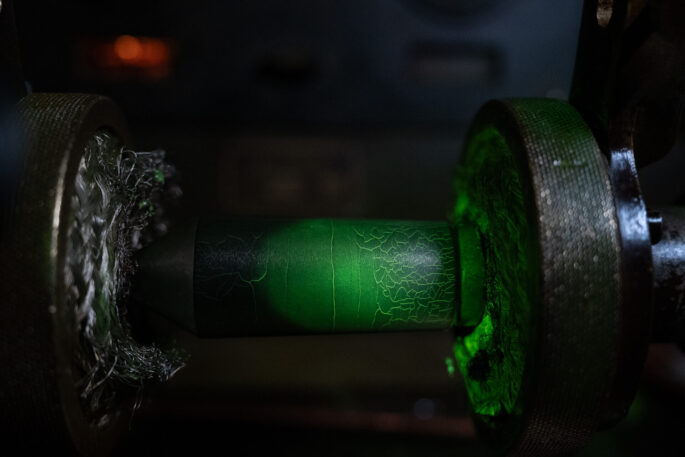
Used to detect surface-breaking defects in metallic components. A fluorescent penetrant is applied to the surface and drawn out of any discontinuities, allowing defects to be identified under ultraviolet light.
Magnetic Particle Inspection (MT)
Suitable for ferromagnetic materials, magnetic particle inspection reveals surface and near-surface defects when magnetised components attract fluorescent particles to areas of discontinuity.
Eddy Current Testing (ET)
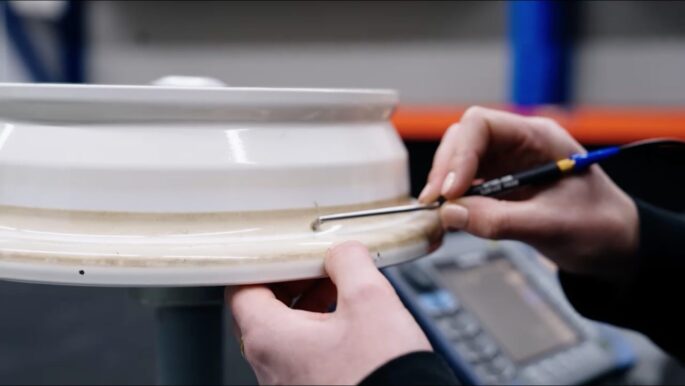
Eddy Current testing uses electromagnetic probes to detect surface and near-surface defects, particularly in aluminium and magnesium components. It is well suited to hole inspections and areas where disassembly may not be practical.
Ultrasonic Testing (UT)
Ultrasonic testing uses high-frequency sound waves to detect subsurface defects in metals and composites. Reflections from internal flaws are measured and analysed to assess material integrity.
All NDT inspections are carried out by trained personnel using approved procedures and calibrated equipment, with clear reporting and traceability.
Improving inspection
outcomes
Correct component preparation plays an important role in maximising the probability of defect detection and reducing turnaround time. For Penetrant (PT) and Magnetic Particle (MT) inspections in particular, surface condition can significantly influence inspection effectiveness.
Fieldair works with operators to ensure:
- Adequate removal of surface coatings or paint where required
- Appropriate preparation methods that do not mechanically deform the surface
Chemical stripping is generally recommended for paint removal. Where blasting is considered, Plastic Media Blasting (PMB) is typically preferred for aluminium and magnesium components due to its minimal peening effect when applied correctly. This practical guidance helps avoid rework, improves detection probability and supports efficient inspection processes.

Talk to our maintenance team
If you require non-destructive testing or would like to discuss inspection requirements for your aircraft or components, our team is available to assist.
Contact Fieldair to speak with our NDT specialists.